Posts

The Practical Side of ILT

Image
The education of those who are going to be pastors is an important topic. There are many things a person who is going to fulfill the office of pastor must learn. Some of the important things a pastor must know can be learned from the classroom or books, but many of aspects of pastoral ministry can only be learned by guided experience. Many know the academic side of ILT. This side of the ILT education of pastors has been widely discussed. ILT students have a reputation of being theologians. While this is a wonderful thing, it should be noted that ILT students learn theology so that they can be better prepared to deal with the very practical concerns each pastor must face. ILT students go through a rigorous study of Biblical theology, systematic theology, and history. These are the more traditional topics which Lutheran pastors have studied in preparation for pastoral ministry. ILT students must also study ethics and philosophy. These topics are always in relation to the theologica...
ILT and Woman's Ordination

Image
Over the past years, some have commented about ILT and the ordination of women because through ILT’s email newsletter and social media it is obvious ILT has students who are women. Let me start by saying that ILT does not have an official position, nor can it ever take an official position on women’s ordination. However, because we do have female students, it is understandable that we receive a question like “Why does ILT ordain women?” There are two facts that need to be made clear. First, ILT has students preparing for pastoral ministry and who, when they graduate, serve as pastors in congregations. Second, ILT is an independent seminary and graduate school and does not belong to any denomination. This means ILT cannot ordain anyone into the office of pastoral ministry. Only churches and church bodies can do this. I can say clearly and with certainty, ILT does not practice women’s ordination, and it will not, because it cannot. We do, however, have many denominations who look to...

One Week after Accreditation

Image
We really did not know how it was going to go. I have often said over the last week that I would not want to play poker against any of our accreditation visitation team or the commission members. They did not in any way let us know what they were thinking about ILT as a candidate for initial accreditation. We did not have a good feeling, either way. However, one week ago, ILT was granted initial accreditation from the Associate for Biblical Higher Education (ABHE). Most people connect to ILT have probably never heard of ABHE until they heard that ILT had decided to receive accreditation from them. Most Lutheran schools are accredited by the Association of Theological Schools (ATS). There were a couple of hurdles for ILT concerning ATS. One is that ATS does not allow for a 100% online learning modality. ATS accreditation would radically change the way ILT approaches online education. Our integrated online approach which combines the academic classroom into the real life ...

The License to Sin

Image
For Sunday morning Bible class the last two weeks, we studied Romans 6 and 7. In these chapters, Paul talks about how we might abuse the grace of God and the gift of salvation offered to us. Paul begins here his conversation with the Christians in Rome about doing good and doing evil. He talks about this in a way different from the way we usually talk about. We might ask if doing this specific work is good or bad. Paul does not deal at the level of the specific but at the level of what is alive in us and in terms of what enslaves us. In chapters one through five, Paul outlines the gift of God's grace which we receive by faith. He first details how we have nothing good in us and how works righteousness is not an option for us because of the corruption of our bodies and the sins we commit. He then goes on to explain that there is a righteousness apart from works we can receive because of Christ through faith. In chapter 6, Paul deals with one improper response to this grace: licent...

The New Year

Image
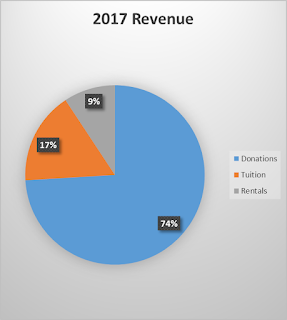
I want to say thank you to all those who have supported ILT in 2017. There are many of you and each of you is important to ILT's success and future. It is difficult to overstate just how much we depend upon each donation we receive. So, from all of us at ILT, I want to give a sincere thank you. We truly appreciate your kindness and generosity. To show just how much this is true, let me tell you a little about ILT's revenue structure. The total operations revenue for ILT in 2017 was $1,163,000. This is the income we received from donations and tuition. We do not pay income tax on this income because it is a part of our non-profit mission. We also received income from the rentals we have in the facility we own. The total rental income, the income we received from library donations, interest and growth on the endowment fund, and other miscellaneous revenue is $118,000. Bottom line, this means ILT had a total revenue of $1,281,000 in 2017. $179,000 of this income was restricte...

The Church Business

Image
I've been accused of being in the "church business" before. Of course, this was from someone who thought that we were simply using Christianity to take money from the susceptible. As if pastors and church leaders were simply exploiting the underlying fears people have concerning death and final judgment so as to acquire donations from them. From this perspective, the church is nothing but a business with a specific business model. We, of course, do not want this stigma. We try to avoid looking like we are merely in the church business for the profit. From the Christian perspective, there is a necessary suspicion about using business language or principles with anything connected to the church. Business is after all inherently corrupt and unethical. The way God calls Christians to live together in faith is antithetical to the way business must necessarily operate. But for a business that is connected to the church, there remain these questions: Is there a way for church-...

Faith and Joyful Suffering

In today's Bible class, we covered the end of Romans chapter four and the beginning of chapter five. In chapter four, Paul comes to the point and then in chapter five he goes beyond it. His point is that anyone who believes in Jesus will be counted as righteous before God. What goes beyond this are the implications for our lives if we believe this. Being a Christian is easy. God does all the work. But it does have an effect on life. Jesus tells a parable about counting the cost of being his disciple. A man does not being building a tower before he is convinced that he has enough resources to complete the project. Likewise, those who would follow Jesus need to count the cost. Paul identifies this cost, or at least part of it, in chapter five. Romans chapters one through four is perhaps the longest instance of Paul's description of the difference between an approach to God based on works verse faith. In these chapters, Paul argues that no one can be saved according to works. Th...

Future for Education?

Image
Yesterday Tim Swenson and I went to a Town Hall meeting hosted by the Association for Biblical Higher Education ( ABHE ) president to discuss possible changes in ABHE. Being fairly new members of the association, this is the first of these that staff from ILT has had the opportunity to attend. It was a fascinating experience for the two of us. This meeting was in response to ABHE's own strategic planning and focused on addressing some threats and opportunities they face. The big question of the day was about how to be prepared for the changes coming in the future of higher education in North America. One of the challenges addressed was the continuing debate between the value of career-focused education and a liberal arts education. There has been a dramatic shift in what potential students believe an education should accomplish. This is a shift from the student wanting to receive a well-rounded broad-based education to an education that will ensure job placeme...

Thinking Strategically

Image
One of the many things the accreditation process has brought to ILT is the requirement of a Strategic Plan. This is a five-year plan addressing our strengths, weakness, opportunities, and threats (SWOT). This allows the administration, faculty, and staff to dream a little. We all agree that ILT does not look like it should yet. It is far from being finished. The Strategic Plan and the process we use to create it gives us the opportunity to think about how we can take ILT from where we are to where we need to be. Based upon the SWOT analysis, the administration has identified seven goals we will be working on in the next five years. These are our goals: Equip more people more effectively for ordained and non-ordained ministry in the church. Enhance ILT's contribution to the theological task. Strive toward consistent and stable operations. Increase financial stability. Increase quality of services to students. Successfully interpret the institution to various constituen...

Two Struggles

In the Book of Romans, Paul identifies two different struggles each Christian must face. In Bible class today, we faced one of those struggles; and boy did we struggle. Today, we studied the first half of Romans chapter four. Our struggle focused on how salvation is a free gift of God's grace. You would not think that it would be a struggle to receive a free gift, but for many people it is. Normal people are skeptical of something that is free. We want to know what the catch is. But when it comes to our relationship with God and with our eternal life, it is even more important. We want to have a part in it. We want to know what we can do. This is the struggle between works righteousness and faith. Paul is very clear that if we earn something by works of the law, then it cannot be a gift. It is an obligation. If we believe in works righteousness, the doctrine that we must earn our place before God, then we do not receive eternal life as a gift from God, but as an obligation. We ea...

Meetings, Oi

People generally hate meetings. They will say one of two things about them. Either they will say, "What a waste of time, we did not get anything done there." Or they will say, "What a waste of time, I have so many better things to be doing with my time than sitting in meetings. I have stuff to get done." I love meetings. This is the time of year that there are more meetings for us. One reason for this is because we are between semesters, so there is more time to focus on things that get laid aside during the semester. The other reason is that there are many things scheduled to be completed during this time of year. I like meetings because of how important they are for the collaboration between different people and offices within the institution. I will admit they can sometimes be painful. We have to listen to people say things we have already heard, or we already know. We have to listen to people lay out a full argument for something we cannot do, or worse, for so...

Forgiveness, Finally!

Image
In Bible class this morning, there was an attitude of thankfulness that we were finally going to talk about the forgiveness of sins instead of the demands of the law and God's wrath. For the last four weeks, we have been studying Paul's words concerning Gods wrath and judgment against sinners. Today, we made the transition to Paul's words concerning the salvation we have received by faith in Jesus which he writes at the end of Romans chapter 3. Today's challenges in Bible class were not about facing the law of God, but in understanding what Paul says about our salvation. Paul begins by saying that there is no righteousness before God through the law, but only through faith in the gift of God's grace; the blood of Jesus that makes atonement for our sins. There are a lot of things happening in that statement. To start with, Paul makes a distinction between being justified before God by our works and being justified by the gift of God. He says that being justified be...

Asking Permission

Image
One of the unique things about an online school is that it exists wherever there is a reliable internet connection. This means there are many places ILT students can live. On a traditional campus, the students move to the state in which the school exists. This school only needs to have official permission from that one state to operate. The school is bound by the rules and regulations established in that one state. It is not so with a school that exists in every state. Distance learning schools have to receive permission to operate in every state in which its students live. The reason for this is because it is the responsibility of the state to protect its citizens from fraudulent schools and schools that do not effectively educate people. In an attempt to fulfill this responsibility, each state must decide what agency will monitor the schools and what qualifies a school to be able to operate in its jurisdiction. It has been interesting for me, as I continue to w...

Just Waiting

The Fall semester is almost over. Next week Tuesday is the last day of class for my course before finals week. In the Fall, I teach Old Testament History and Theology for the certificate program. This week we studied the period between the Old Testament and the New. The question I try to answer for the students in this lesson is: How do we go from the return to Jerusalem from exile and the rebuilding of the temple at the end of the Old Testament to the Roman occupation as it is in the Gospels? The rebuilding of Jerusalem is basically done by 500 BC and Malachi is thought to have prophesied about 430 BC. This means that there are about 500 years of history between the Testaments. I find the history of this time to be rather depressing. It is a time of constant change for those who live in Judah and there is no word from God about what it means. Throughout the Old Testament, there are times of trouble. For the most part, these times of trouble are related to immoral kings...

Circumcision; That Can't Be Undone

Image
For Bible class this Sunday, we are going to continue looking at Paul's letter to the Romans. This week we are looking at the end of chapter two and the beginning of chapter three. This section is the continuation and conclusion of Paul's opening argument. He argues in these first few chapters that all people are condemned under the law. His opening argument is that the judgement of God is being revealed from heaven against all sin. He then goes on to make a distinction between God's judgment and ours. Just because we know the law does not mean we can judge others, instead we must wait for the judgment of God. In this final section, he is going to attack the false security the Jews have in their race and religion. There is some difficulty here for us modern readers. So much of the history of the West concerns the persecution of the Jews that Paul's words have a different tone for us than what he intended. Paul is a Jew. He goes to great length in Galatians to prove ho...

A Plan for Planning

Image
Today was the scheduled day for the administration to meet and begin working on the Strategic Plan. This is the day Dennis, Jon, Tim, and I begin the process to identify all those things that we need to do as an institution and prioritize them over the next five years. It is the day designated for us to think about the future ILT and draw a map to get there. It is one of the most fun activities that we get to do as administration. This process is a part of the planning required by the accreditation agency. It is one step in a much larger process that includes assessment, planning, and evaluation. It is a process that requires information from students, donors, investors, board members, faculty, and staff. The assessment part happens when surveys are sent out, data sets are compared to historical data and data from other institutions, and reports are gathered from every part of the institution. This assessment is analyzed by the board, faculty, and staff to identify strengths and ...

Judge It All!

Image
This week, we continue to look at Paul's letter to the Romans at our church Bible study. In his second chapter, Paul addresses one issue that can arise from reading chapter one. That is the issue of being judgmental. We can react to the law in many ways. One reaction is to push back because of the accusation we feel from the law. Another is to judge others according to it. Paul writes chapter two specifically against those who would judge. It is so easy, hearing a list of sins, to think immediately about those others who do such things. As if we don't. It creates an "us versus them" dichotomy. A position from which we have the high ground. It is so easy to see the sins in others. Jesus, of course, speaks against this attitude in the Pharisees.  Here, I am thinking specifically about Jesus' parable telling us to take the plank out of our own eye first. When the law is preached, it is not about our ability to judge others; it is about God's judgment of us. W...

Keeping ILT at a Distance

Image
It is not immediately apparent what ILT means by online education or distance learning. ILT is an online school in the sense that we do not have students in classrooms on site. All of our students come to their classes using online software. However, there are many ways the internet has been used to deliver education to off-site students. What ILT does is different than those typical means used by other online schools. Let me explain. ILT is dedicated to creating as much of a traditional classroom as is possible using an online environment. The key component is to use a system that will allow students and faculty to communicate as if they were all in the same room together. ILT does this using an online software system called Adobe Connect. This system is a video conferencing system which is designed to allow a presenter to share documents, power points, and video to a class of students who are also using a video feed to participate in class. ILT is different than traditional o...

More than Just Junk Mail

Image
In our advancement meeting this week, we were talking about ILT's end of the year fundraising campaign. This is the biggest yearly fundraiser for ILT and this year we have a donor who is willing to match $150,000 of donations received by January 21, 2018. This is exciting for us, but for many people, it is just another piece of junk mail on their dining room table at night. I, of course, understand this attitude toward a donation letter. I have the same attitude for many of the appeal letters I receive in the mail on a regular basis. So let me tell you a little bit about how ILT uses the money we receive from donors. The money is used in one of two ways. Some donations are restricted to a specific use by the donor. These funds are used in accord with the wishes of the donor. Mostly, these are donations given to the financial aid fund or other special projects. ILT budgets $30,000 a year to help students who have financial need. Last year we received $121,023 doll...

Our Wrath against God's Wrath

We are studying Paul's letter to the Romans in the Bible study I teach at my church. This week, we looked at Paul's opening argument in chapter one starting with Romans 1:18. Paul is not always easy to read and this text says many controversial things about God's wrath and our sin. Most of us, if we are Christian, understand clearly God's revelation in Jesus Christ. God reveals his love, mercy, and grace toward us in the gospel. But, if God's grace is revealed through the preaching of the gospel, how is God's wrath revealed? Paul says, "The wrath of God is being revealed from heaven." Paul argues that this is against all human ungodliness and unrighteousness which suppresses the truth. It is evident there is a God and that he is the creator. Paul says this is clearly revealed to us through creation. The eternal attributes of God can be clearly seen in the world he created. Humans, however, do not honor God as creator. Instead, we have made idols...